
What The Most Rigorous Assessment Available Found
Apr 20, 2026
In 2019, a family court judge concluded that Kate Markland was emotionally unfit to parent.
No formal psychological assessment by a qualified psychologist or psychiatrist was conducted. No validated clinical tools were applied.
This raises a precise question: what was the 2019 assessment actually measuring?
What a valid psychological assessment requires
The British Psychological Society and Family Justice Council’s joint guidance (Psychologists as Expert Witnesses in the Family Courts in England and Wales, January 2016) sets minimum standards for psychological assessments. A valid assessment requires:
- A qualified, regulated practitioner (HCPC-registered or BPS-chartered)
- Use of validated clinical tools
- Access to relevant records, including medical history
- Sufficient time to distinguish enduring traits from situational responses
Validated tools exist to separate a person’s underlying psychological state from how they present under stress. That distinction is essent
Research on the stress response (Siegel, 2020) shows that threat can produce behaviours—emotional dysregulation, distress, difficulty presenting coherently—that may be misread as instability. These are normal neurological responses, not evidence of disorder.
Interpreting stress responses in an adversarial legal setting as proof of unfitness is circular, not clinical.
The Cambridge finding
In 2019, University of Cambridge researchers reported that family court decisions are often distorted by misuse of psychological concepts.
They identified a systemic issue: decisions based on contested interpretations rather than validated methods.
What the GP records show
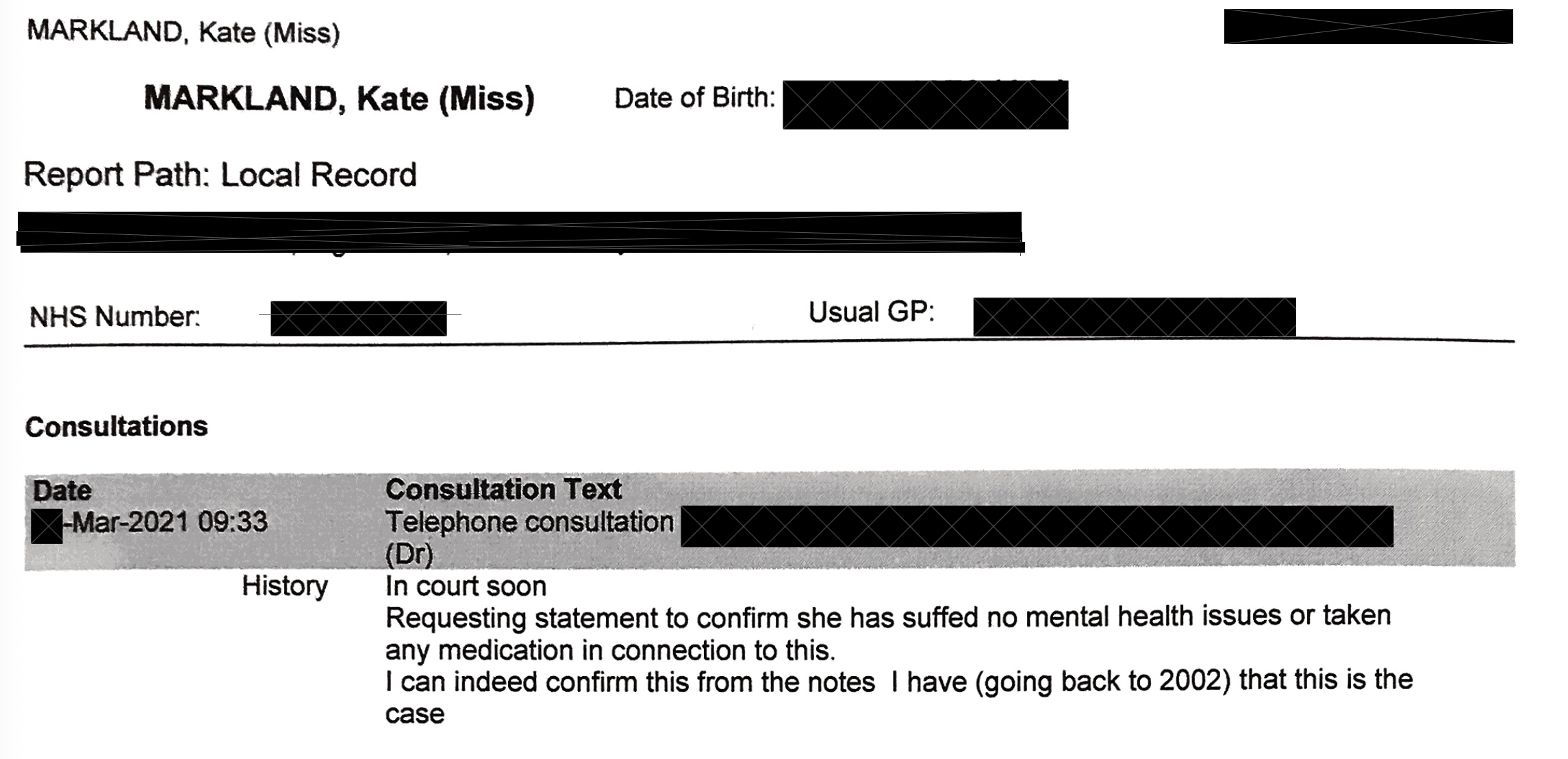
Kate’s GP records span nearly two decades and show no mental health concerns, no referrals, and no psychiatric treatment, no medication, no clinical indicators consistent with emotional unfitness.
What the subsequent assessment showed
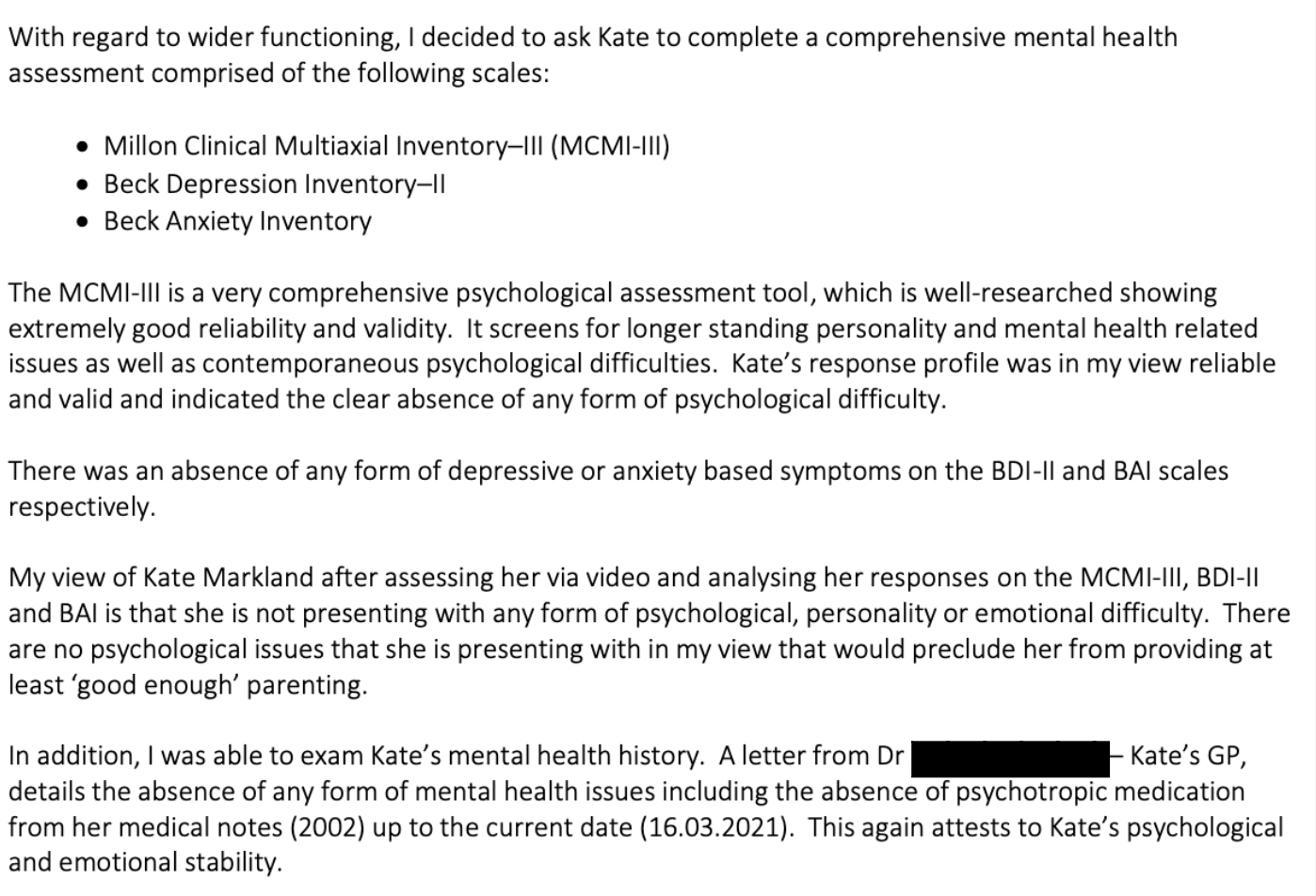
A later assessment used validated instruments: MCMI-III, BDI-II, and BAI. These tools assess both enduring personality patterns and current psychological state.
Results were clear:
- Valid and reliable response profile
- No evidence of depression or anxiety
- No indication of personality disorder or emotional instability
The results were unambiguous. The response profile was assessed as valid and reliable. Across all measures, there was a clear absence of psychological difficulty.
No evidence of depression. No evidence of anxiety. No indication of personality disorder or emotional instability.
The clinical conclusion was straightforward: there are no psychological, personality, or emotional issues that would prevent Kate from providing good enough parenting.
This aligns with the broader clinical picture: no substance misuse, no offending history, and no mental health concerns across two decades.
In the psychologist's own words
"The MCMI-III is a very comprehensive psychological assessment tool, which is well-researched showing extremely good reliability and validity. It screens for longer standing personality and mental health related issues as well as contemporaneous psychological difficulties. Kate's response profile was in my view reliable and valid and indicated the clear absence of any form of psychological difficulty."
"There was an absence of any form of depressive or anxiety based symptoms on the BDI-II and BAI scales respectively."
"My view of Kate Markland after assessing her via video and analysing her responses on the MCMI-III, BDI-II and BAI is that she is not presenting with any form of psychological, personality or emotional difficulty. There are no psychological issues that she is presenting with in my view that would preclude her from providing at least 'good enough' parenting."
"A letter from Dr [redacted] — Kate's GP, details the absence of any form of mental health issues including the absence of psychotropic medication from her medical notes (2002) up to the current date (16.03.2021). This again attests to Kate's psychological and emotional stability."
"From direct questioning, there is also the absence of any form of offending history and/or substance misuse which represent other major factors normally needed to be reviewed in connection with parenting fitness."

Kate arranged this assessment herself. It was not court-ordered.
She chose to undergo comprehensive testing using the very instruments the court process did not apply. The results confirmed what the GP records already showed: no psychological barriers to parenting.
The issue is not interpretation. It is professional overreach.
The BPS and FJC guidance is explicit: without proper methodology, a conclusion about emotional fitness is not a valid psychological assessment.
The 2019 determination was not clinically grounded. The subsequent assessment meets professional standards. The earlier conclusion does not.
This is not a matter of interpretation. It is a matter of professional boundaries.
Judges are not clinically qualified to assess psychological fitness without expert input. The 2019 process operated outside those boundaries.
Kate did not fail a clinical assessment. No valid clinical assessment was conducted.
The later evidence does not just contradict the original finding, it demonstrates that it was reached without the standards required to support it.
That is professional overreach. And the evidence, sourced entirely from the profession's own governing bodies, says so.
Judges Are Not Clinically Qualified to Assess a Parent's Emotional Fitness documents the judicial determination this assessment directly contradicts.
Lawyers, Mental Health and the Advice Nobody Should Have to Follow documents that the lawyers advising in those same proceedings were themselves operating below the clinical threshold their own profession applies.
Who Is Fit to Judge? documents what the judiciary's own data says about the fitness of the people making the final determinations.
References
- British Psychological Society and Family Justice Council. (2016). Psychologists as Expert Witnesses in the Family Courts in England and Wales: Standards, Competencies and Expectations. Joint guidance from the Family Justice Council and the British Psychological Society. Leicester: British Psychological Society. Available at: www.bps.org.uk
- University of Cambridge news release: "Family court decisions distorted by misuse of key research, say experts" (12 January 2021). https://www.cam.ac.uk/research/news/family-court-decisions-distorted-by-misuse-of-key-research-say-experts
- Siegel, D. J. (2020). The developing mind: How relationships and the brain interact to shape who we are (3rd ed.). New York: Guilford Press. ISBN: 9781462542758.
- Duschinsky, R., Forslund, T., Granqvist, P. et al. (2021). Attachment goes to court: Child protection and custody issues. Attachment & Human Development. DOI: 10.1080/14616734.2020.1840762 [University of Cambridge-led international consensus statement identifying systemic misuse of attachment research in family court decisions.]
- Millon, T. (1994). Millon Clinical Multiaxial Inventory–III manual. Minneapolis: National Computer Systems. [MCMI-III: validated clinical instrument used in the subsequent assessment.]
- Beck, A. T., Steer, R. A. & Brown, G. K. (1996). Beck Depression Inventory–II. San Antonio: Psychological Corporation. [BDI-II: validated clinical instrument used in the subsequent assessment.]
- Beck, A. T. & Steer, R. A. (1990). Beck Anxiety Inventory manual. San Antonio: Psychological Corporation. [BAI: validated clinical instrument used in the subsequent assessment.]